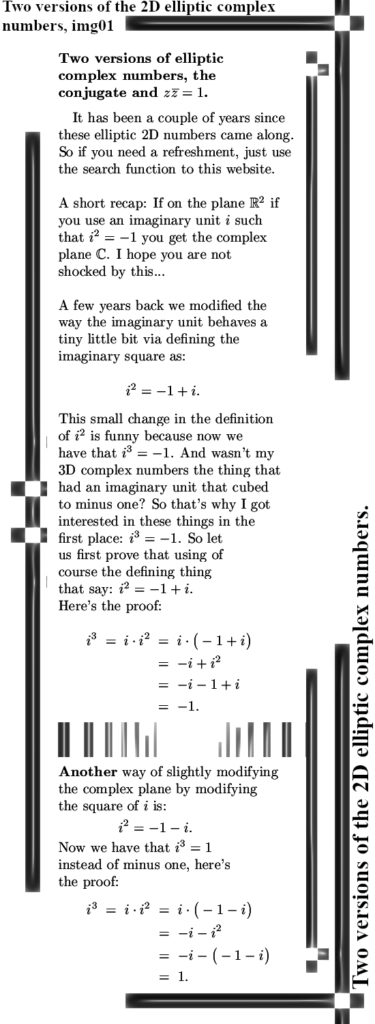
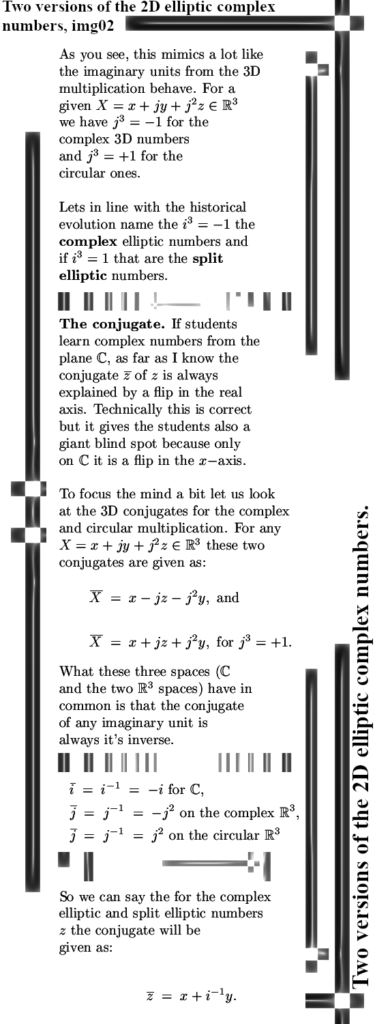
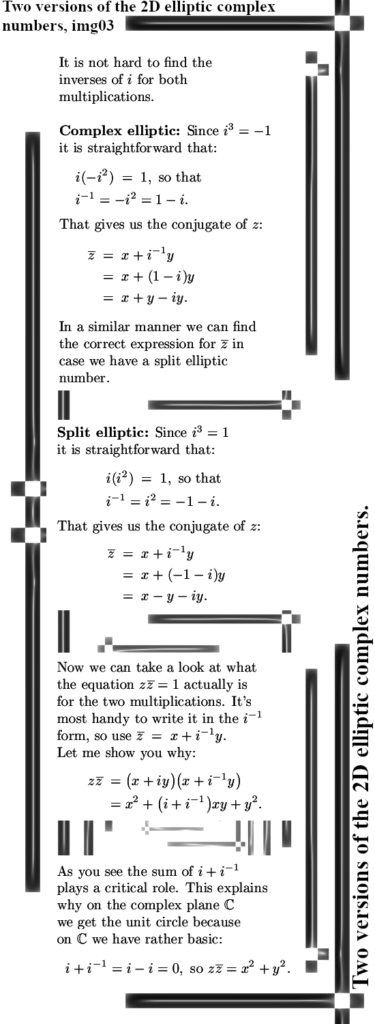
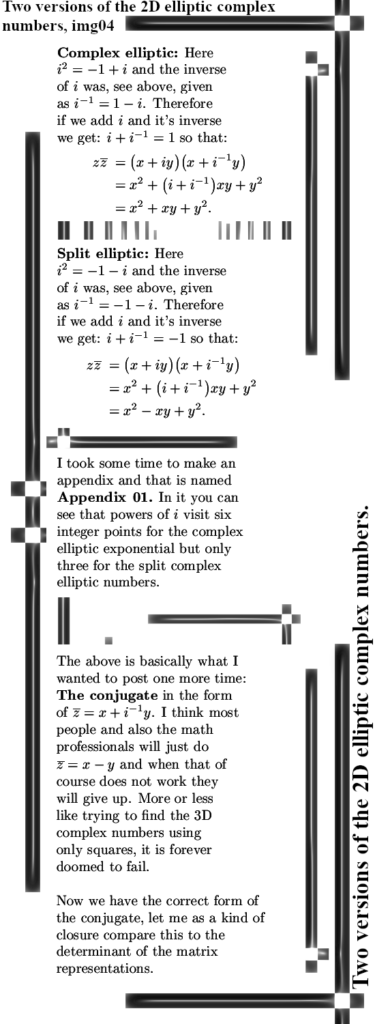
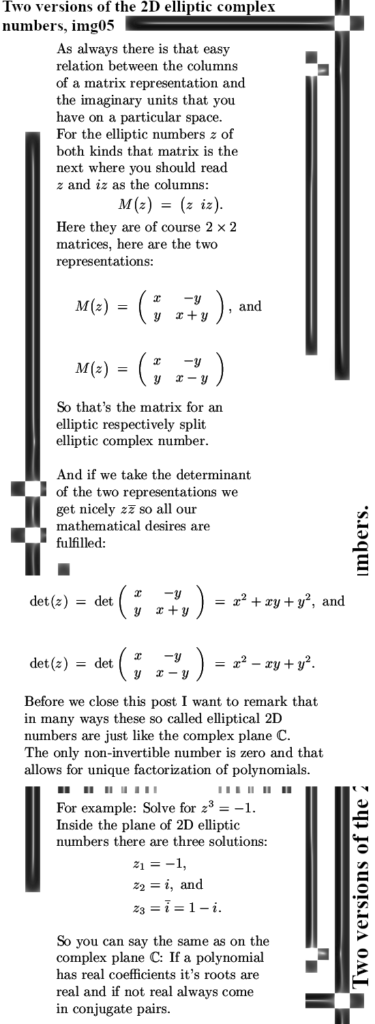
The main reason for me writing this post is once more showing you how to take a conjugate when it is not as simple as “A reflection into the x-axis”. I am now in my sixties when it comes to my age and to be honest in my entire life I have never seen just one person doing it right. All they do is flip it into the x-axis and when their calculations derail they just throw away the whole thing and never think twice about what they are doing.
A better way of formulating a conjugate is the next: Replace all imaginary units by their inverse. And yes, in case of the standard 2D complex plane that is a reflection in the x-axis. But that does not mean that in every space where a conjugate is a meaningful thing it will be a reflection. In the case of this post it surely is not a reflection and likely that is the reason that these kind of elliptic complex numbers are completely unknown to the professional math profession. In that regard it is the same as say the 3D complex numbers; also completely unknown because they are to stupid to adjust the math when that’s needed. In some highly autistic version of reality the conjugate must be a flip in the real axis and these people are totally blind for what they do wrong.
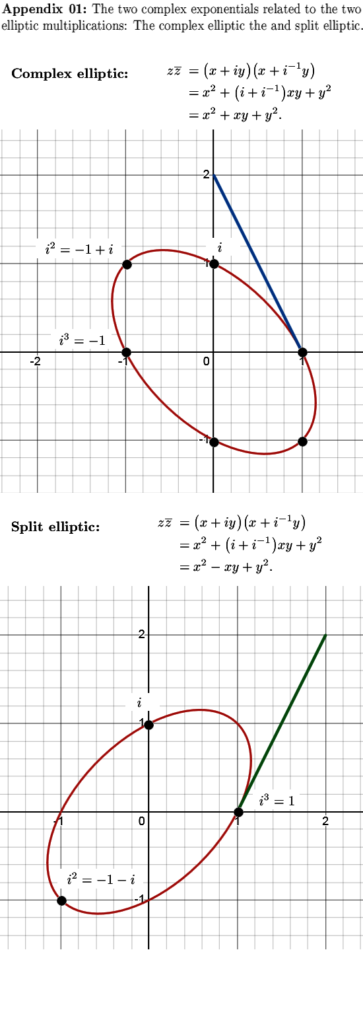
This post is five images long and an extra addendum with the two graphs of the ellipses that form the complex exponential on these two relatively simple spaces. May be the next post is about finding those famous numbers tau, on this entire website a number tau is always the logarithm of a suitable imaginary unit. Because a 2D number space is very simple we have only one imaginary unit of course written as i and tau is the log of i.
The direction of the tangents in the point z = 1 is the direction of the number tau. That is a simple yet effective idea from Sophus Lie who a long long time ago invented those things we now know as Lie algebra’s and Lie groups. So on the one hand if you already know what tau is, all you do is differentiate the complex exponential. And if you haven’t found the precise value for tau you can always use implicit differentiation on the equations that define the complex exponential, in this case the equations for the two ellipses. You can use that for checking your calculations for the number tau because those calculations have a strong tendency to run if the rails but if you get the wrong direction you now know there must be a calculation error somewhere…
Ok that was it for this post and this is the 300-th post on this website. As you might have noticed I don’t write more or less two posts a months, only about one. With 300 posts on higher dimensional number systems I have done enough and there is no use in repeating things over and over again. That was it for this post, as always thanks for your attention.